Tianfu Yongxing Laboratory Releases the Evaluation Report on Ecosystem Carbon Sink Resources in Sichuan Province in Collaboration with Multiple Research Institutions
Release Date:2025-06-05
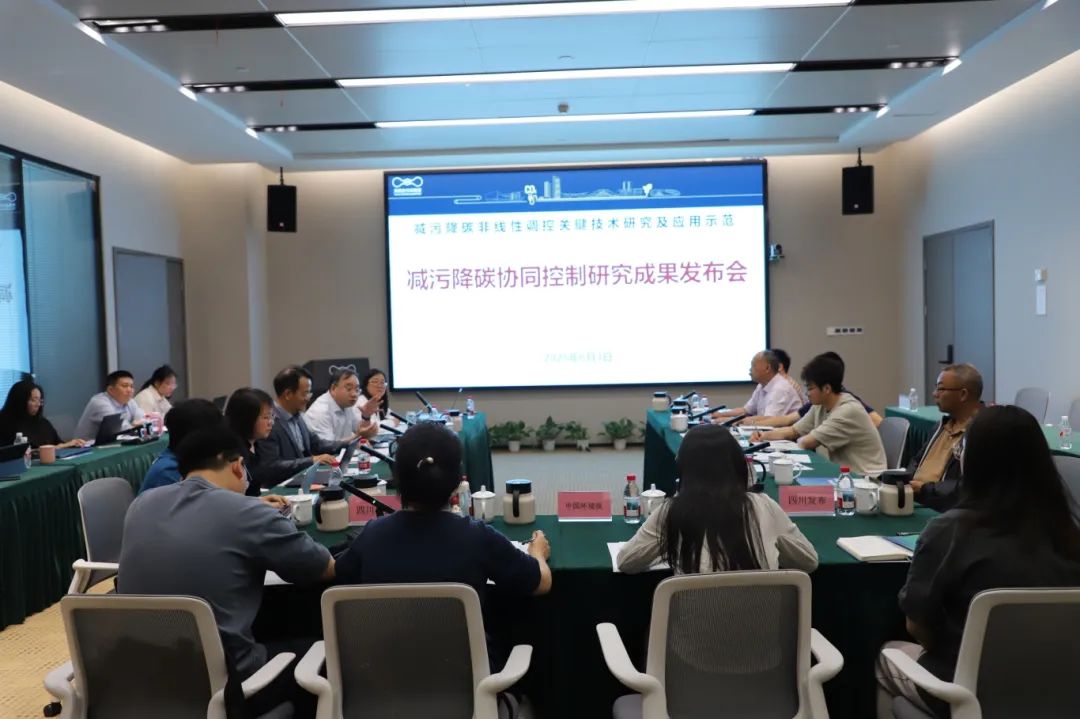
On June 3, Tianfu Yongxing Laboratory (hereinafter referred to as "the Laboratory") held the Release Conference of Research Achievements on Controlling and Synergizing the Reduction of Pollution and Carbon Emissions. At the conference, the Laboratory officially released the following reports in collaboration with multiple research institutions, including Evaluation Report on Ecosystem Carbon Sink Resources in Sichuan Province, Evaluation Report on Ecosystem Carbon Sink Resources in Yibin City, Evaluation Report on Ecosystem Carbon Sink Resources in Aba Tibetan and Qiang Autonomous Prefecture, and Innovative Typical Cases of Synergizing the Reduction of Pollution and Carbon Emissions.
The Evaluation Report on Ecosystem Carbon Sink Resources in Sichuan Province has been jointly released by Tianfu Yongxing Laboratory, the Aerospace Information Research Institute, Chinese Academy of Sciences, the Sichuan Academy of Environmental Policy and Planning, the Sichuan Forestry and Grassland Survey and Planning Institute, and the Institute of Mountain Hazards and Environment, Chinese Academy of Sciences, Chengdu. With remote sensing monitoring and model simulation technologies, the report comprehensively analyzes the current status, carbon sink enhancement potential, dynamic changes in carbon sink gains and losses, and asset valuation of ecosystem carbon sink resources in Sichuan Province, providing robust scientific support for the conversion of ecological product values and the achievement of the carbon peaking and carbon neutrality goals.
Significant Total Carbon Sink Resources, Dominated by Forestry and Grassland Ecosystems
The evaluation reveals that the total ecosystem carbon sink in Sichuan Province reached 386 million tons of carbon dioxide equivalent (hereinafter referred to as "tCO₂e") in 2024, with forest and grassland carbon sinks contributing 303 million tCO₂e, accounting for 78.5%. Forest carbon sinks, as the core component, constitute 89% of the total forest and grassland carbon sinks, while grassland carbon sinks account for 11%. From a temporal perspective, the average annual carbon sink resource volume over the period from 2014 to 2024 was 325 million tCO₂e, with the forestry and grassland system contributing 78%, highlighting its role as the "main force" in carbon sequestration.
Immense Carbon Sink Enhancement Potential with Significant Regional Variations
The report indicates that theoretically, the forest and grassland carbon sink enhancement potential in Sichuan Province reaches 350 million tCO₂e, with that of forest accounting for 89.7%. Compared with the historical peak in 2016, there is a potential for an additional 44.82 million tCO₂e. Taking the Zoigê landscape project as an example, ecological restoration has led to a 55.1% increase in regional carbon sinks. However, ecological risks remain a concern: landslides in Junlian County and Mao County, as well as forest fires in Liangshan Prefecture and Yajiang County, resulted in a carbon sink loss of approximately 109,000 tCO₂e.
Substantial Carbon Sink Assets with Significant Regional Disparities
Preliminary evaluations suggest that the average annual total asset value of forest and grassland carbon sinks in Sichuan Province reaches RMB 3.841 billion. In terms of spatial distribution, three prefectures of Ganzi, Aba, and Liangshan form the core advantage zones for carbon sinks, contributing 66.9% of the province's total carbon sink volume and 76.3% of its asset value. Regions such as the Chengdu Plain, northeastern Sichuan, and southern Sichuan exhibit differentiated characteristics, necessitating tailored strategies for carbon sink enhancement.
Establishing a Closed-Loop Management System and Innovating Asset Management Tools
An innovative space-air-ground integrated ecosystem carbon sink resource management platform has been developed, which deeply integrates advanced technologies such as remote sensing monitoring and big data analysis. This platform constructs a closed-loop management system covering "precise resource accounting-dynamic monitoring and tracking-asset benefit evaluation", providing comprehensive technical support for the efficient management of regional carbon sink assets and scientific decision-making at the provincial, municipal, and county levels.
To strengthen the asset management of ecosystem carbon sink resources in Sichuan Province, the following recommendations are proposed:
Region-specific exploitation of carbon sink enhancement potential: Strengthen the collaborative carbon sequestration through water conservation and biodiversity protection in three prefectures (Ganzi, Aba, and Liangshan), promote the collaborative carbon sequestration through ecological restoration and industrial development in areas surrounding the basin, and enhance carbon sequestration through urban construction in harmony with nature in the basin area; improve the quality of forest carbon sinks, restore wetlands to increase carbon sinks, enhance the carbon sink resources of terraced fields, strengthen grassland carbon sink management, reduce soil erosion, develop local characteristic carbon sinks, construct ecological corridors and forest parks in urban agglomerations, and advance three-dimensional greening projects such as urban roof greening and vertical forests.
Classified prevention and control of risks leading to carbon sink reduction: Enhance fire risk prevention and control capabilities by establishing a three-dimensional protection system, a space-air-ground monitoring matrix, and an AI early warning system; scientifically identify landslide risks, implement real-time dynamic evaluations, and undertake multi-dimensional slope reinforcement projects; strengthen ecological management and control throughout the entire lifecycle of development and construction, coordinate spatial layouts, establish a carbon sink compensation mechanism, innovate industrial carbon sink quota management, and promote the decoupling of industries from carbon emissions.
Construction of a resilient carbon sink system: Promote the establishment of a climate-adaptive carbon sink enhancement system, optimize vegetation structure and composition, and construct a dynamic monitoring network; build a three-dimensional chain-like disaster prevention and control system, strengthen coordinated prevention and control measures for rainstorms and landslides, advance linked response mechanisms for high temperatures and fires, innovate rapid post-disaster carbon sink recovery mechanisms, and comprehensively enhance the resilience and disaster response capabilities of the carbon sink system.
Support for the realization of carbon sink asset values: Scientifically identify strategic locations, focus on areas such as Panzhihua-Xichang Region and Zoigê to create high-efficiency core zones, drive the potential conversion in northeastern and southern Sichuan, and expand urban collaborative demonstrations in the Chengdu Plain urban agglomeration; foster collaborative development among government, enterprises, and research institutions, establish reserve pools, improve service systems, expand application scenarios, promote diversified carbon sink development, and contribute to the realization of the province's carbon sink industry and carbon peaking and carbon neutrality goals.
Serving National Strategies and Creating a Model for a Beautiful Sichuan
The report emphasizes that scientific evaluation and efficient management of carbon sink resources are key pathways for balancing ecological protection and carbon neutrality goals, providing solid technical support for the scientific management of carbon sink resources and assets at the provincial, municipal, and county levels. By enhancing the value of carbon sink assets and innovating management systems and mechanisms, further progress can be made in building a "Beautiful Sichuan".
In the next step, with the integration of satellite remote sensing, IoT sensing devices, and ground verification, and relying on digital technology empowerment, the accuracy of ecosystem carbon sink resource evaluation will be improved through a four-level linkage mechanism at the provincial, municipal, county, and project levels. Dynamic updates will be implemented for carbon sink resource assets in forests, wetlands, grasslands, and other ecosystems across the province, precisely serving the diversified ecological value conversion needs of forest, grassland, farmland and wetland carbon sinks, and assisting in the development and certification of carbon sink projects such as CCER.
 Tel
Tel Postal
 Address
 川公网安备51010502015325号