Attaining Carbon Peaking and Carbon Neutrality: High-level Innovative Platform Turns Technology Achievements into a New Driving Force
Release Date:2023-10-10
“Reaching carbon peaking and carbon neutrality is an extensive and profound revolution in the socioeconomic system.”
On the journey towards achieving the carbon peaking and carbon neutrality goals, energy and industrial structures will change accordingly. Similarly, modes of production, life, and socioeconomic development will undergo unprecedented transformations. Amidst these changes, there will be brand-new opportunities for the future development. In this context, the crucial questions arise: How can we effectively achieve the carbon peaking and carbon neutrality goals? How can we seize development opportunities of times?
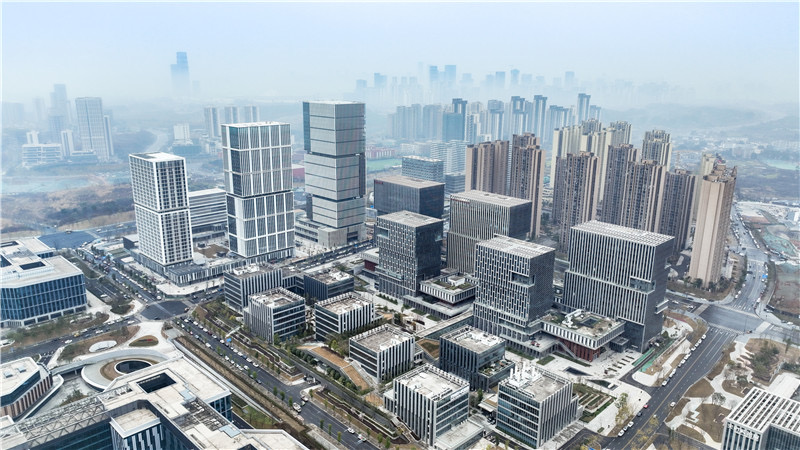
Situated by the Xinglong Lake in Chengdu City, Sichuan Province, Tianfu Yongxing Laboratory is one of the four key laboratories within the Tianfu Laboratory network. Presently, this Laboratory is mobilizing collective expertise to tackle stranglehold problems in the field of carbon neutrality and is exploring specific pathways to achieve the carbon peaking and carbon neutrality goals with scientific and technological innovation. In this process, how to boost transition, conversion, and industrialization of technological achievements, in order to forge a new driving force to facilitate socioeconomic low-carbon development? Recently, reporters of Chengdu Daily Guanjin News entered Tianfu Yongxing Laboratory to unravel how such a high-level innovative platform stimulates technological innovation, so as to bridge the gap between laboratory innovations and practical implementation.
Establishing an Operational System for Transforming Technological Achievements Through Seed Selection, Cultivation, and Incubation
After the Mid-Autumn Festival and the National Day of the People’s Republic of China, Qin Zhangjian, Head of Achievement Conversion Department of Tianfu Yongxing Laboratory, was busy with identifying projects, visiting scientists, and contacting investors, throwing himself in “selecting potential seeds”.
Tianfu Yongxing Laboratory has built an operational system for scientific and technological achievement conversion with a three-step process, namely seed selection, cultivation, and output. Qin Zhangjian has been actively involved in selecting seeds among high-quality achievements, which possess great market potential, serve as complements to what’s missing in industries, or can be used as Chinese home-made substitutes to imports by adopting a method of cultivating junior teachers and introducing experienced talents from enterprises. Simultaneously, he has been cultivating these seeds through funding these scientific and technological projects of achievement conversion. Furthermore, he encourages individuals who finish such achievements to pursue incubation at companies registered in Tianfu New Area. Moreover, Qin Zhangjian engages with external investment organizations to secure funding for startups.
“Among them is the project of the new on-load tap changer controlled by permanent magnet”, said Qin Zhangjian. While introducing their recent significant endeavors in the exhibition hall of Tianfu Yongxing Laboratory, he gave the following example. When new energy power sources such as photovoltaic power and wind power are connected to grid on a large scale, there is frequent and significant fluctuation in busbar voltage around the connection points. This results in corresponding jumps in the frequency of voltage regulation. This phenomenon may have impact on the grid voltage stability and electric energy quality, and even bring about such potential problems as blocked secondary lines or reduced stable operating boundaries. Due to frequent voltage regulations, mechanical tapping of traditional on-load tap changer occurs more frequently, thus speeding up the changer’s aging.
“Utilizing magnetic field control, the continuous on-load tap changer technology replaces mechanical tapping with magnetic control to continuously regulate the output terminal voltage, which could deal with mechanical wear and tear, delayed response times, and high costs of maintenance, among other problems. This continuous on-load tap changer will be an upgraded alternative to present one”, Qin Zhangjian stated. This project, the on-load tap changer controlled by permanent magnet, will not only propel industrial transformation of this technology and serve as an upgraded substitute for the traditional mechanical tap changer, but also bring in considerable economic benefits. More importantly, this technology tackles realistic technological bottlenecks when photovoltaic power is connected to grid. Besides, improved function of voltage control will remarkably level up the voltage control of power distribution network, and enhance power quality, yielding greater technological and economic benefits.
Notably, this project is researched and developed jointly by Sichuan Energy Internet Research Institute of Tsinghua University. There have been significant contributions from Southwest Jiaotong University and Southwest Petroleum University to transportation and energy fields respectively, as well as research achievements from universities and scientific research institutions including Sichuan University and Chengdu University of Technology. Given that situation, Tianfu Yongxing Laboratory aims to harness and amplify these dispersed strengths, while advancing technology and achievement conversion.
Currently, with a total of 11 projects of its internal potential achievement conversion, Tianfu Yongxing Laboratory intends to select the most promising ones and give them special supports in achievement conversion, so as to put in place its technological achievement conversion and cultivate micro, small and medium-sized enterprises in the field of science and technology.
A Network of Universities + Enterprises + Laboratories Serves as Links and Complements to Each Other’s Innovative Niche
“Most of the research projects in the Laboratory are oriented towards the demands of enterprises and markets, and paying attention to applying technology research and integrated innovation”, Qin Zhangjian said. He told the reporters of Chengdu Daily Guanjin News, Tianfu Yongxing Laboratory is backed by Tsinghua University, Peking University, and Sichuan University, among other 10 plus universities and scientific research institutions, for their basic research achievements serve as a source of applying technology research and integrated innovation conducted by the Laboratory.
In Qin Zhangjian’s view, laboratories can provide the best high-level innovative platform to advance “technological innovation and achievement conversion simultaneously”. This is because “Universities generally emphasize basic researches; while enterprises largely put emphasis on industrialization and market operation. Consequently, there is a gap between the basic research achievements of universities and enterprises’ productization. The Laboratory, however, can play a crucial role in narrowing and bridging such a gap.” Based upon current basic research achievements of universities and scientific research institutions, the Laboratory supplies mature products and technology to enterprises through putting into use technology research and integrated innovation, Qin Zhangjian noted.
Unblocking the innovation chain, spanning from “Basic Research - Technological Research and Development - Engineering Application - Industrial Development”, is one of the significant mission facing Tianfu Yongxing Laboratory. The Laboratory asserts its development direction, namely “Being led by basic researches and dominated by technology application, fostering technological integrated innovation, and creating industrial clusters”. Therefore, the Laboratory, universities and enterprises, all of these elements become links and complements to each other’s innovative niche. “Regarding research contents of the Laboratory, there are suppliers and demanders. Besides, we are forming a stable and powerful scientific research team, ensuring the continuous delivery of technological innovation.”, Qin Zhangjian mentioned.
It is reported that, as of now, the Laboratory has introduced 65 full-time talents. Among them are 1 national leading talent, 1 high-level talent at provincial level, and 30 doctors. Remarkably, as high as 98% of the talents possess master’s degrees or higher qualifications, and over 90% of these talents were graduated from universities that participate in China’s “Double-First Class” initiative. Apart from that, giving full play to its advantages in talent resources of multiple types, the Laboratory has also flexibly introduced 111 expert talents to work at the Laboratory by adopting diversified innovative talent employment methods, such as full-time, dual, and part-time employment arrangements. These methods are also employed by the partners of the Laboratory, including universities, scientific research institutions, and enterprises.
Qin Zhangjian emphasized, “This is attributed to a sound working and living environment in Chengdu and its regional development trend. Besides, this province provides a raft of talents with platforms and opportunities for their development.” Just as infrastructure, such as roads and water supply pipe networks, is indispensable to the development of a city, continuous supports of guarantied conditions, including talents, platforms,and funds, are necessary for technological innovation. The Laboratory serves as “infrastructure” for technological innovation. Only by building high-level laboratory innovative platforms can technological innovation could be better carried out. “Once shifted, transformed, assimilated, and mastered by enterprises, technological achievements of laboratories could be translated into modern products and services that benefit society and economy. Technological innovation of the Laboratory will drive regional adjustment in economic structure and industrial upgrade and transformation.”
13 Research Centers Have Been Established with the Focus on 6 Major Research Directions
As the first provincial-level laboratory focused on carbon neutrality in China, Tianfu Yongxing Laboratory was ceremoniously launched on December 23, 2021, by the the shores of Xinglong Lake, Tianfu New Area, Sichuan Province. The Laboratory’s inauguration is considered as a firm move forwards improving independent innovation ability in carbon peaking and carbon neutrality across Sichuan, and is seen as a supportive high-level innovative platform to create a cradle for significant advanced green and low-carbon technology innovation in China.
According to Qin Zhangjian, renowned for clean energies, Sichuan Province has a unique advantage that is evident in its rich recyclable energy resources. Notably, 80% of Sichuan’s total power is generated by hydropower. Meanwhile, its solar and wind power sources as well as natural gas storage and generation rank among the highest in China. In fact, Sichuan Province is “born” with an advantage to reach “carbon neutrality” goal.
Leveraging this advantageous position, Tianfu Yongxing Laboratory is dedicated to establishing itself as a regional innovative center with influence at home and abroad, thereby integrating into the “national team” in the field of carbon neutrality.
Qin Zhangjian told the reporters of Chengdu Daily Jinguan News, “Recently, the Laboratory is conducting researches focused on Clean and Low-carbon Energy, Resource Carbon Neutrality, Carbon Capture and Utilization, Carbon Sink and Geological Carbon Sequestration, Pollution and Carbon Reduction, Integrated Coupling under Carbon Neutrality, and other fields related to carbon neutrality.” In spite of its outset of construction, the Laboratory has secured important progress. For instance, it has established the Research Center for New Power Systems, the Research Center for Zero-carbon Energy Systems, the Research Center for New Principles and Technology of Carbon Dioxide Capture, among 13 research centers. It is carrying out organized scientific researches in order centered on research contents and tasks that are demonstrated during the establishment of these research centers. In addition, the Laboratory has undertaken some of the major national, provincial, and municipal projects.
According to “A Strategic Development Plan for Tianfu Yongxing Laboratory (2022-2030)”, the Laboratory will not only make intensified efforts in its 3 to 5 important basic original technologies related to carbon neutrality and obtain breakthroughs in 20 to 30 key application technologies, but nurture 3 to 5 green and low-carbon high-tech enterprises.
Looking ahead, Tianfu Yongxing Laboratory will fully invigorate researchers in innovation and creation, boost technological breakthroughs and achievement conversion in research. This effort aims to support Chengdu’s acceleration in building an influential scientific and technological innovation center across China, characterized by high-quality science and technology.
[ By Wu Yifei from the Chengdu Daily Jinguan News ]
 Tel
Tel Postal
 Address
 川公网安备51010502015325号